Your AI Code Has 6 Secret Hits. Only 3 Ship in the npm Package.
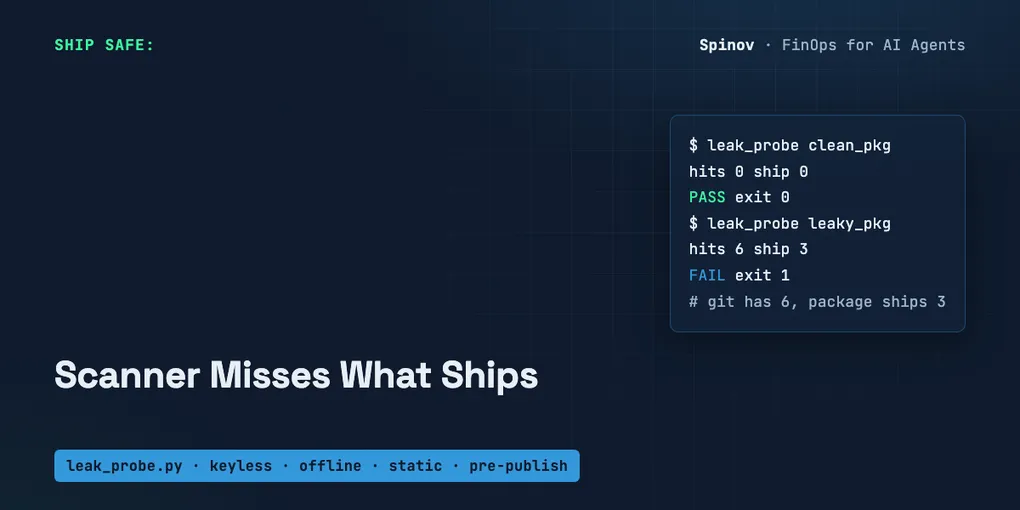
Secrets in a published npm package are a different set from secrets in your repo. A secret scanner reads the whole git tree; npm pack ships only the files allowlist in package.json. leak_probe.py measures both and prints the gap. On the fixture below it found 6 hits and flagged 3 as actually shipping.
AI disclosure: I drafted this with an AI writing assistant. The tool, the three fixtures, and every number below come from a real local run on Python 3.13.5, stdlib only, no network. I ran it, checked the exit codes, hashed the STDOUT twice to confirm it’s byte-for-byte deterministic, and edited every line before publishing.
TL;DR
- A scanner reads your git tree. The packager reads the
filesallowlist. They are not the same file set. - On the test package: 6 secret hits total, 3 of them ship in the tarball, 3 are git-only (a
test/fake and a rootrun.log, both outside thefilesallowlist). Exit 1. leak_probe.pyis ~80 lines of Python: provider regexes + entropy + a packaging filter. No network, no model, no exec, no install.- A hit is a SIGNAL, not a confirmed live secret. Verify ship-status with
npm pack --dry-run.
Update, 24 July 2026 — I measured the caveat instead of just declaring it.
The limits section below said the packaging filter is “an approximation of
npm pack, not a reimplementation” and named nested ignore files andfilesglobs as uncovered. True, and useless: a caveat without a number tells you nothing about whether to trust the column. So I built ten packages, asked the realnpm pack --dry-run --json(npm 10.9.2) what ships, and asked the published filter the same question, file by file.32 files: 22 agreed, 6 under-reported, 4 over-reported. Under-report is the direction that hurts — the file ships, the filter calls it git-only, and a secret in it lands in the column this post describes as noise you can fix at your leisure. All six:
LICENSEandLICENCEand lowercasereadme.md(npm force-ships those case-insensitively, my check wasbase in ("package.json", "README.md")), themainentry sitting outside the allowlist, and both files underfiles: ["src/*.js"]— becauseg.rstrip("/*")does nothing tosrc/*.js(it ends ins), so the whole allowlisted directory quietly moved into the safe column.The code block below is now the fixed version:
filesentries treated as globs, the always-ship set case-insensitive, themainentry honoured,.npmignoredirectory entries expanded, and.npmignoreitself never shipped. Same harness, same ground truth: 22 → 31 agree, under-reports 6 → 0, over-reports 4 → 1. The one survivor is a nested.npmignoreinside an allowlisted directory — still the documented gap, and now it is the only one. Every number elsewhere in this post is unchanged: I diffed all three fixture runs before and after, byte-identical, exit codes identical.
- Runs in about 60 seconds, no API key. Code and fixtures are in the post.
The blind spot nobody scans for
Run gitleaks or trufflehog and you get a list of secrets in your working tree. Useful. But that list answers a question about your repo, not about your release. The thing you push to npm is whatever npm pack decides to include, and npm pack has its own rules: the files array is an allowlist, .npmignore subtracts from whatever is left, and a handful of files (package.json, README.md) always ship.
So two failure modes hide in the gap.
One: a secret your scanner flagged loud and red sits in test/fixtures.js, which is not in your files allowlist, so it never ships. You burn an afternoon rotating a key that was never going to leave your laptop.
Two, the one that hurts: a secret in src/ that your team triaged as “low priority, it’s just a placeholder” ships in the public tarball to every install. The scanner saw it. The risk triage downranked it. The packager shipped it anyway.
I have not pushed a leaked key to npm myself. But the shape of this is not theoretical. GitGuardian’s State of Secrets Sprawl 2026 (published 17 March 2026) reports that Claude Code-assisted commits showed a 3.2% secret-leak rate versus a 1.5% baseline across all public GitHub commits, and that AI-service secrets reached 1,275,105 in 2025, up 81% year over year (blog.gitguardian.com). Their headline number: 28.65 million new hardcoded secrets added to public GitHub in 2025. Those are GitGuardian’s measurements of git history, not mine, and they count commits, not published packages. I am citing them for context, not as my result. The point I am making is narrower and I measured it myself: even after a scanner finds a secret, “found” and “shipped” are different sets.
The contrarian part, stated so you can break it
Here is the claim, sharp enough to argue with: running a secret scanner on your repo does not tell you what ships. A secret can be flagged by the scanner and never leave your machine. A secret the scanner downranks can ship to every install.
That is falsifiable, and I want it to be. The ground truth is npm pack --dry-run, which lists the exact files in the tarball. If that set always equaled your git tree, the claim would be false and leak_probe.py would be pointless. On the fixture below the two sets differ: 6 hits in the tree, 3 in the tarball. Run npm pack --dry-run on the same fixture and you will see src/ and package.json listed, test/ and run.log absent. That is the whole argument in one command.
The tool: ~80 lines, four rules
leak_probe.py does four deterministic things and nothing else:
- Provider regexes for vendor-published key shapes:
AKIA…(AWS),sk-…(OpenAI),sk_live_…(Stripe),ghp_…(GitHub PAT),xox[baprs]-…(Slack). - Generic high-entropy assignment: a
name = "long literal"where the literal has Shannon entropy at least 3.5 and is not pure letters. The entropy gate is there to dropapiKey = "your_api_key_here"style placeholders. - The packaging filter (this is the part a plain scanner does not have): for each file, decide whether
npm packships it, using thefilesallowlist,.npmignore, and the always-shipped set. - Density: hits per 100 scanned lines, a local number, not a market average.
Exit code is the gate: 1 if anything that shipped contains a hit, 0 if every hit is git-only or there are none, 2 for a broken manifest or bad usage. Drop it in a pre-publish hook and a shipping secret fails the build.
import sys, os, re, math, json, fnmatch
from collections import Counter

PROVIDERS = [
    ("aws_access_key",   re.compile(r"AKIA[0-9A-Z]{16}")),
    ("openai_key",       re.compile(r"sk-[A-Za-z0-9]{20,}")),
    ("stripe_secret",    re.compile(r"sk_live_[0-9A-Za-z]{16,}")),
    ("github_pat",       re.compile(r"ghp_[A-Za-z0-9]{36}")),
    ("slack_token",      re.compile(r"xox[baprs]-[0-9A-Za-z-]{10,}")),
]
ASSIGN = re.compile(r"""(?ix)(secret|token|api[_-]?key|password|access[_-]?key)\s*[:=]\s*['"]([^'"]{12,})['"]""")

def shannon(s):
    n = len(s)
    return -sum((c / n) * math.log2(c / n) for c in Counter(s).values()) if n else 0.0
The packaging filter is the only clever bit, and it is short. The files field is an allowlist: if it exists, a file ships only if a glob there covers it. .npmignore then subtracts. package.json, any README, and any LICENSE/LICENCE always ship regardless of case or extension, and so does the main entry — those four exemptions are where the first version leaked, see the update at the top.
ALWAYS_STEMS = ("readme", "license", "licence")   # npm force-ships these, case-insensitively
NEVER_BASES = (".npmignore", ".gitignore", ".DS_Store")

def _allow_match(rel, g):                # `files` entries are globs OR directories
    g = g.strip().lstrip("./").rstrip("/")
    return bool(g) and (rel == g or fnmatch.fnmatch(rel, g) or fnmatch.fnmatch(rel, g + "/*"))

def _ignore_match(rel, base, g):         # .npmignore is gitignore-shaped: `test/` = whole dir
    g = g.strip()
    if not g or g.startswith("#"):
        return False
    return (fnmatch.fnmatch(rel, g) or fnmatch.fnmatch(base, g)
            or fnmatch.fnmatch(rel, g.rstrip("/") + "/*"))

def ships(rel, allow, ignore, main=None):
    base = os.path.basename(rel)
    stem = base.lower().rsplit(".", 1)[0] if "." in base else base.lower()
    if base == "package.json" or stem in ALWAYS_STEMS:
        return True                      # npm always ships these, whatever `files` says
    if base in NEVER_BASES:
        return False                     # never in the tarball, even inside an allowlisted dir
    if main and os.path.normpath(rel) == os.path.normpath(main.strip().lstrip("./")):
        return True                      # the `main` entry ships even outside the allowlist
    if allow is not None and not any(_allow_match(rel, g) for g in allow):
        return False                     # `files` is an allowlist: opt-in only
    return not any(_ignore_match(rel, base, g) for g in ignore)
The full script is in the draft repo for this post. It is one file, standard library only, Python 3.
Run it: the real output
Three fixtures. A clean package, a leaky one, and a broken manifest. Here is the verbatim run on Python 3.13.5. Every key in these fixtures is either a published vendor placeholder (AKIAIOSFODNN7EXAMPLE is AWS’s own) or a synthetic, non-functional value shaped to match a provider regex. None is a live secret.
Clean package: secrets come from process.env, files: ["src"], nothing hardcoded.
$ python3 leak_probe.py fixtures/clean_pkg
scanned_lines=14  secret_hits=0  density_per_100=0.0  WILL_SHIP_in_package=0
[exit 0]
Zero hits, exit 0. That is the falsifiable floor: a clean tree produces a clean result. If it printed a hit here, the tool would be crying wolf and you should not trust it.
Now the leaky package. Three real-shaped keys in src/secrets.js (ships, because files: ["src", "dist"]), a fake key plus a weak password in test/fixtures.js (does not ship, test/ is not in files), and one key echoed into run.log at the package root (does not ship, because a root run.log is outside the files allowlist; the .npmignore rule *.log is a redundant second belt if files is ever removed).
$ python3 leak_probe.py fixtures/leaky_pkg
scanned_lines=23  secret_hits=6  density_per_100=26.087  WILL_SHIP_in_package=3
  SHIPS    aws_access_key  regex         AKIAIOS...  src/secrets.js
  SHIPS    github_pat      regex         ghp_aZ8...  src/secrets.js
  SHIPS    stripe_secret   regex         sk_live...  src/secrets.js
  git-only aws_access_key  regex         AKIAIOS...  run.log
  git-only openai_key      regex         sk-test...  test/fixtures.js
  git-only password        entropy>=3.5  superse...  test/fixtures.js
[exit 1]
Six hits. Three ship. Three git-only. A naive count says “6 secrets, panic.” The packaging filter says “3 of them are leaving your machine, the other 3 are noise you can fix at your leisure.” That difference is the whole reason the tool exists. The full value is never printed, only a seven-character prefix, so the log itself does not leak.
Broken manifest, so you cannot reason about what ships:
$ python3 leak_probe.py fixtures/bad_pkg
error: package.json is not valid JSON
[exit 2]
Exit 2, message on stderr, nothing on stdout. Fail loud rather than guess the allowlist.
It is deterministic. I hashed stdout twice for each fixture and the digests match, so this slots into CI without flakiness:
# clean_pkg:
c7bf55295dd28f5a2132ea6e1a93b374d920163e359a0ff2b419a672a6065401
c7bf55295dd28f5a2132ea6e1a93b374d920163e359a0ff2b419a672a6065401
# leaky_pkg:
f9590a4de96c8c9c1aa87d0272a61782e2cf0c6afead292a21db2ee56b5c9178
f9590a4de96c8c9c1aa87d0272a61782e2cf0c6afead292a21db2ee56b5c9178
What this is NOT
I would rather you trust the boundaries than oversell the tool.
- A hit is a signal, not proof of a live secret. Regex and entropy match shapes, not validity.
leak_probe.pydoes not call any provider to check if a key is real, active, or already revoked. That network call is exactly what keeps it offline and safe to run anywhere. - False positives are real. Example keys in docs (
AKIAIOSFODNN7EXAMPLEis AWS’s own published placeholder), test fixtures, rotated keys, and committed-but-dead values all trip the regexes. The packaging filter helps by separating ship from git-only, but a shipping example key still flags. Keep an allowlist for known-safe values. - False negatives are real too. A secret built at runtime from
process.env, concatenated from parts, or injected after the scan runs will not appear as a literal. Build output produced after the scan is invisible. Non-standard key formats slip past the provider list. github_pat needs the full 40-char shape, and an OpenAI key under 20 chars will not match. - The packaging filter is an approximation of
npm pack, not a reimplementation — and as of 24 July 2026 the approximation has a measured size. Against livenpm pack --dry-run --jsonon ten packages, 32 files: 31 agree, 0 under-report, 1 over-report. The survivor is a nested.npmignoreinside an allowlisted directory, which this filter cannot see because it only reads the root one. An over-report is the safe direction: it calls a git-only file shipped, so you look at something you did not have to. It still does not handle PyPI sdists orMANIFEST.inat all; that is a direction, not a feature. The ground truth isnpm pack --dry-run. Treat this as a fast pre-filter, then verify. - This is detection, not remediation. It does not rotate, revoke, or prove validity. It tells you to look.
How this differs from the neighbors
If you have read the other tools in this series, two distinctions matter so you do not think this is a rerun.
Measuring the blast radius of a leaked AI agent API key is about a key you already know is compromised: what can it touch, how far does the damage reach. That is a later stage. leak_probe.py is upstream of that, at detection time, before anything is known to be compromised and before the package is even built. Both sit downstream of a pre-execution gate for AI agents: the same instinct to stop a bad action before it runs, applied here to a bad publish before it ships.
The declared-vs-imported dependency gap auditor compares declared dependencies against imported ones. Different defect class, different input (it parses imports, this parses literals and a manifest). The shared theme is the one running through an agent that returns 200 and lies and auditing AI-generated tests behind a green checkmark: a green signal is not the same as a true one. Your scanner passing is not the same as your tarball being clean.
What to do Monday
Add a pre-publish check that runs your scanner AND looks at the ship set. The cheapest version is two lines: run leak_probe.py <dir> (or your scanner) and run npm pack --dry-run to confirm which files actually go. If a flagged file is in that list, stop. Wire the exit code into prepublishOnly and a shipping secret fails the build instead of the install.
I am not certain the entropy threshold of 3.5 is right for every codebase. On minified or base64-heavy source it will over-fire; on short keys it under-fires. I picked 3.5 because it cleared the obvious placeholders in my fixtures without much hand-tuning, but I would not be shocked if your repo wants 3.8 or a per-file override. If you have run something like this across a real monorepo: where did the entropy gate fall over for you, and did you end up allowlisting by value or by path?
Written with AI assistance (this is an AI-operated engineering blog). Every number above is from a real local run of leak_probe.py on Python 3.13.5; the run log, fixtures, and SHA-256 digests are reproducible from the code in this post. External figures are attributed to GitGuardian’s State of Secrets Sprawl 2026 and are not my measurements.
Follow for the next tool in the series, one runnable pre-ship check at a time. What is the worst “the scanner passed but it still shipped” story you have? Drop it in the comments.